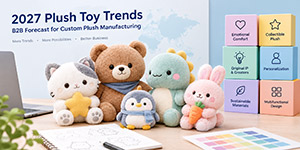








The global plush toy market is entering a more diversified stage in 2027. Plush products are no longer limited to traditional children's toys. They are increasingly connected with emotional comfort, character IP, lifestyle products, collectibles, social media culture, gifting, and branded merchandise.
For B2B buyers, the most important question is not simply which plush toys will become popular in 2027. The more important question is which trends can be converted into commercially viable products that can be prototyped, manufactured consistently, scaled efficiently, and reordered over time.
Based on current changes in plush product development, consumer behavior, online culture, and B2B sourcing requirements, several product directions are likely to become increasingly important in 2027.
This forecast is intended for brands, retailers, IP owners, designers, creators, promotional companies, and other buyers planning custom plush products for the 2027 market.
Trend 1: Emotional Comfort Plush Becomes a Mainstream Lifestyle Category
One of the strongest directions for 2027 is the continued expansion of plush toys from children's products into emotional and lifestyle products.
Consumers increasingly view plush toys as companions, decorative objects, comfort products, and collectible characters rather than simply toys. This creates opportunities for brands to develop products specifically for teenagers, young adults, and adult consumers.
In 2027, successful comfort plush designs are likely to emphasize softness, approachable proportions, simplified facial expressions, and tactile appeal. Animals such as bears, bunnies, cats, dogs, capybaras, seals, whales, and other gentle characters can work particularly well because their silhouettes naturally communicate calmness and friendliness.
Color selection is also important. Neutral colors, soft pastels, warm beige, cream, muted blue, soft green, and light brown can make plush products easier to integrate into bedrooms, offices, dormitories, and lifestyle retail environments.
For B2B buyers, the major advantage is product longevity. A comfort-oriented plush does not necessarily depend on a short-lived internet meme or seasonal event. A well-designed character can become an evergreen SKU and support repeat production.
The main production consideration is that softness becomes part of the product value proposition. Fabric selection, filling density, stitching, shape retention, and surface finishing therefore need to be controlled carefully.
Key B2B Insight
| B2B Factor | 2027 Direction | Practical Guidance |
|---|---|---|
| Target audience | Teens, adults & families | Design beyond children's toys |
| Main value | Comfort & companionship | Prioritize softness and touch |
| Visual style | Simple & friendly | Avoid excessive details |
| Color | Muted & lifestyle-oriented | Use versatile colorways |
| Product lifespan | Long-term | Develop evergreen characters |
| Production priority | Consistent softness | Control fabric and filling |
In short, emotional comfort plush is likely to become a stable product category rather than a temporary trend. For B2B buyers, it offers opportunities for long-term product development and repeat manufacturing.
Trend 2: Internet-Popular Animals Evolve into Original Plush Characters
Social media will continue to influence plush toy development in 2027, but the relationship between internet trends and product development is changing.
Instead of simply turning a viral animal or meme into a plush toy, brands are increasingly likely to develop recognizable original characters based on animals that already have strong online appeal.
Capybaras, frogs, axolotls, otters, cats, dogs, red pandas, ducks, and other visually distinctive animals can provide strong starting points for character development. However, the commercial value comes from creating a recognizable identity rather than copying a temporary online trend.
For B2B buyers, the ideal approach is to build a character system that can support multiple products. One core character could become a plush doll, keychain plush, cushion, bag charm, pillow, or seasonal variation.
This approach provides greater flexibility than producing a single viral SKU.
Production feasibility should also be considered during character development. Simple silhouettes, manageable component counts, repeatable fabrics, and standardized construction can significantly improve consistency during mass production.
Key B2B Insight
| B2B Factor | 2027 Direction | Practical Guidance |
|---|---|---|
| Trend source | Social media & online culture | Monitor trends but avoid direct copying |
| Character strategy | Original IP | Build recognizable identities |
| Product structure | Multi-product ecosystem | Plan extensions early |
| Design | Simple & distinctive | Prioritize silhouette |
| Production | Repeatable construction | Avoid unnecessary complexity |
| Long-term value | Character ownership | Develop reusable IP assets |
The key lesson for 2027 is simple: viral attention can start a product, but a strong character can build a product line.
Trend 3: Original IP and Character Merchandise Become More Important
As brands, illustrators, content creators, game studios, and independent designers continue to develop their own intellectual property, custom plush manufacturing is becoming an important part of character commercialization.
In 2027, more plush projects are likely to start with an illustration, character sheet, digital artwork, mascot, game character, comic character, or creator-owned IP rather than an existing mass-market toy concept.
This creates a major opportunity for custom plush manufacturers because the challenge is not simply producing a standard animal shape. The manufacturer must translate a two-dimensional or digitally designed character into a three-dimensional soft product.
Important development factors include proportion conversion, facial expression accuracy, embroidery or printing methods, fabric selection, color matching, structural support, and sample modification.
For IP owners, the prototype stage is especially important. A character that looks correct in an illustration may not automatically translate into a successful plush product. Small changes in head-to-body ratio, eye placement, ear position, or stuffing structure can significantly change the character's appearance.
Key B2B Insight
| B2B Factor | 2027 Direction | Practical Guidance |
|---|---|---|
| Main source | Original IP & character design | Start with accurate artwork |
| Main challenge | 2D-to-3D conversion | Use professional prototyping |
| Quality priority | Character accuracy | Control proportions carefully |
| Decoration | Embroidery, printing & appliqué | Select techniques by artwork |
| Commercial value | IP merchandise | Plan a product family |
| Manufacturing need | Flexible customization | Work with experienced factories |
For 2027, Custom Plush manufacturing will increasingly function as an IP commercialization service, not simply as a traditional toy production process.
Trend 4: Small Plush, Keychains and Bag Accessories Continue to Grow
large plush toys remain important, but smaller plush products are becoming increasingly attractive for B2B buyers because they are easier to distribute, collect, gift, and combine with other products.
Plush keychains, bag charms, mini dolls, clip-on plush, and small character accessories can create lower-price entry points for customers who may not immediately purchase a large plush toy.
This is particularly useful for IP brands and creators because one character can be developed in several sizes.
Small plush products also work well with blind-box, collectible, promotional, event, and fandom-oriented business models.
However, miniaturization creates its own production challenges. Small embroidered details, narrow limbs, tiny accessories, and complicated shapes can become more difficult to manufacture consistently.
For B2B buyers, the best strategy is not simply to make an existing large plush smaller. The product should be redesigned specifically for its final size and usage scenario.
Key B2B Insight
| B2B Factor | 2027 Direction | Practical Guidance |
|---|---|---|
| Product size | Mini & collectible | Develop multiple sizes |
| Main use | Bags, gifts & collecting | Design for portability |
| Price positioning | Accessible entry products | Create lower-price SKUs |
| Main market | IP & fandom | Build character collections |
| Production risk | Small details | Simplify miniature elements |
| Packaging | Individual & collectible | Plan packaging with product |
Small plush products can therefore serve as an important bridge between character merchandise and everyday consumer products.
Trend 5: Lifestyle Plush Moves Further Beyond the Traditional Toy Shelf
In 2027, plush products are likely to appear across an even wider range of retail environments.
Instead of being sold only in traditional toy stores, plush products can increasingly be positioned through gift shops, bookstores, lifestyle stores, home décor channels, entertainment brands, cafés, museums, fashion-related stores, and online creator shops.
This changes the design requirements.
Lifestyle plush generally benefits from restrained colors, clean silhouettes, high-quality fabrics, and designs that can fit naturally into modern interiors.
Products such as plush cushions, animal pillows, character pillows, decorative plush, and soft home accessories can therefore become important extensions of traditional plush collections.
For B2B buyers, the advantage is channel diversification. A product designed for lifestyle retail can potentially reach customers who are not actively shopping for toys.
Key B2B Insight
| B2B Factor | 2027 Direction | Practical Guidance |
|---|---|---|
| Retail channel | Lifestyle & gift | Design beyond toy stores |
| Product role | Décor + companionship | Increase visual versatility |
| Design | Minimal & refined | Reduce unnecessary details |
| Materials | Soft & premium | Fabric quality matters |
| Sales potential | Multi-channel | Plan different applications |
The broader opportunity is to treat plush as a lifestyle product category, not only a children's toy category.
Trend 6: Sustainable Plush Moves Toward Verifiable Materials and Production
Sustainability is expected to remain an important B2B consideration in 2027, but the focus is shifting from marketing language toward measurable product and supply-chain information.
For buyers, simply describing a product as “eco-friendly” is becoming less meaningful. More purchasing decisions are likely to depend on material specifications, recycled content, certifications where applicable, packaging choices, production processes, and documentation.
Recycled polyester fabrics and recycled polyester filling can provide practical options for brands seeking to reduce the use of virgin materials. However, sustainability should not be considered separately from softness, durability, color consistency, safety testing, and production stability.
For custom plush manufacturers, the challenge is maintaining the same material specifications during repeat production. A sustainable sample has limited value if mass production uses different materials or inconsistent components.
Key B2B Insight
| B2B Factor | 2027 Direction | Practical Guidance |
|---|---|---|
| Buyer expectation | Evidence & documentation | Define materials clearly |
| Material trend | Recycled materials | Evaluate performance as well as claims |
| Production | Repeatability | Maintain specifications |
| Packaging | Reduced material use | Optimize packaging design |
| Brand risk | Greenwashing | Avoid unsupported claims |
| Supply chain | Transparency | Keep material records |
For 2027, sustainability should be treated as a product-development and sourcing requirement, rather than simply a marketing message.
Trend 7: Plush Collections Will Outperform Isolated Products
One of the most important B2B product-development changes in 2027 may be the move from individual plush products toward coordinated collections.
A single plush character can have limited commercial potential. A collection can create multiple purchasing opportunities.
For example, a brand could develop a character family consisting of different animals, sizes, colors, expressions, outfits, accessories, and seasonal versions.
The same manufacturing platform can potentially support multiple SKUs while maintaining a consistent visual identity.
This approach also improves merchandising. Customers can collect multiple characters instead of purchasing only one product.
From a manufacturing perspective, collection planning can help standardize fabrics, filling materials, embroidery techniques, packaging formats, and production processes.
Key B2B Insight
| B2B Factor | 2027 Direction | Practical Guidance |
|---|---|---|
| Product strategy | Collections | Plan multiple SKUs |
| Character system | Consistent | Establish visual rules |
| Manufacturing | Shared components | Standardize materials |
| Merchandising | Collectible | Encourage repeat purchases |
| Inventory | Flexible | Build multiple price points |
The strongest plush programs in 2027 may therefore be those designed as product ecosystems rather than isolated SKUs.
Trend 8: Customization and Small-Batch Production Become More Valuable
The traditional plush business often favors large-volume production, but the growth of independent brands, creators, crowdfunding projects, social commerce, and niche IP is creating demand for more flexible manufacturing.
In 2027, B2B buyers may increasingly look for manufacturers that can support the complete development process—from artwork review and material selection to prototype development, sample modification, bulk production, quality control, packaging, and shipping.
This is particularly important for smaller brands and creators that cannot immediately commit to very large production quantities.
The value of a custom plush manufacturer is therefore not determined only by factory capacity. Design communication, sample accuracy, development efficiency, quality control, and the ability to manage different types of custom projects can be equally important.
Key B2B Insight
| B2B Factor | 2027 Direction | Practical Guidance |
|---|---|---|
| Buyer type | Brands, creators & IP owners | Support different project sizes |
| Service | End-to-end customization | Connect design to production |
| Development | Faster prototyping | Reduce sample iterations |
| Production | Flexible batch planning | Match volume to market demand |
| Quality | Consistency | Maintain sample-to-bulk accuracy |
| Supplier value | Manufacturing + development | Evaluate the complete service |
For 2027, flexibility may become a stronger competitive advantage as the plush market becomes more fragmented and specialized.
2027 Plush Toy B2B Forecast: What Should Buyers Prioritize?
Based on these trends, B2B buyers planning plush products for 2027 should focus on five fundamental principles:
-
Develop characters, not just individual products.
-
Design for multiple channels instead of relying only on traditional toy retail.
-
Consider production feasibility during the design stage.
-
Use customization to create stronger differentiation and IP value.
-
Build products that can support repeat orders and long-term collections.
The most promising plush products in 2027 are unlikely to be defined by one specific animal, color, or viral character. Instead, successful products will combine emotional appeal, recognizable design, practical manufacturing, flexible commercialization, and long-term brand value.
Conclusion
The 2027 plush toy market is likely to become more diversified, character-driven, lifestyle-oriented, and commercially sophisticated.
Emotional comfort plush, original character IP, internet-inspired animals, collectible mini plush, lifestyle products, sustainable materials, coordinated collections, and flexible customization are all important directions for B2B buyers to consider.
However, trends alone do not guarantee commercial success.
For brands and IP owners, the critical step is translating a trend or character concept into a manufacturable product. Fabric selection, pattern development, embroidery, printing, appliqué, stuffing, sample development, quality control, packaging, and mass production all influence the final result.
The best 2027 plush products will therefore be those that combine consumer relevance with manufacturing feasibility.
For B2B buyers, the goal should not be to follow every trend. It should be to identify the trends that fit the brand, develop them into distinctive products, and work with a capable custom plush manufacturer to turn those concepts into scalable product lines.
Custom Plush Project Showcase
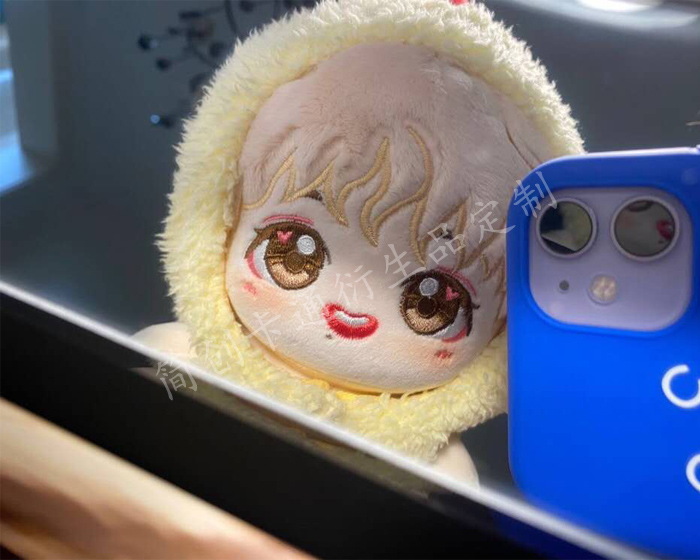
Custom Plush Pendant Factory
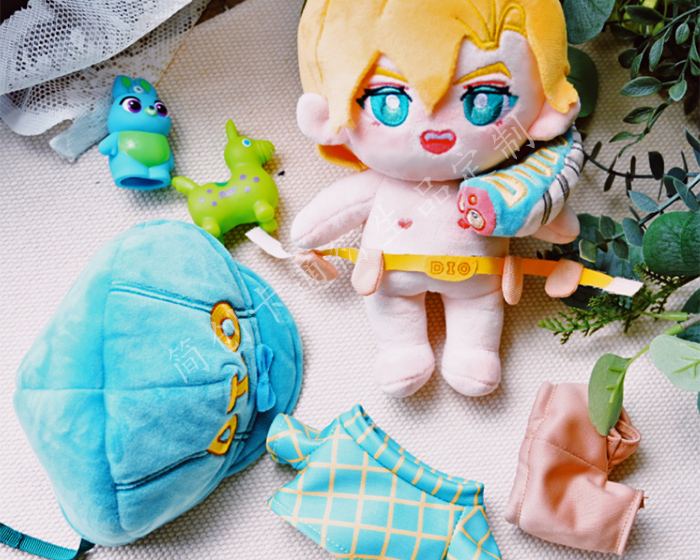
Custom Warmies Stuffed Animals Manufacturer
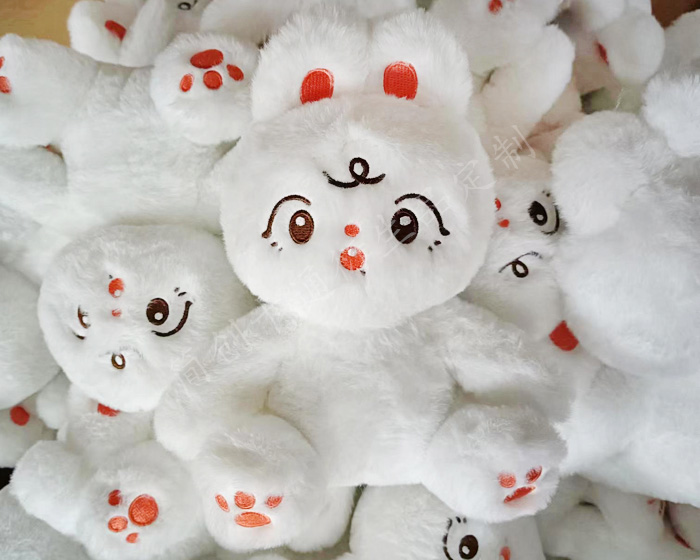
Custom Stuffed Animals Manufacturers
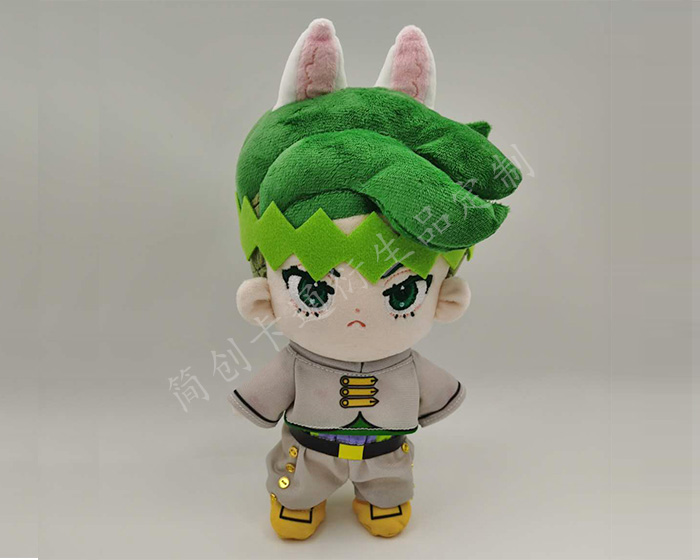
Custom Plushies Manufacturers

Custom Dumpling Plush Factory
-
Custom Plush Doll Manufacturer
-
6cm Custom Plush Pendant Manufacturer
-
Custom Weighted Plush Toys Manufacturer
-
Custom Plush Stuffed Doll Manufacturer
-
Custom Cute Stuffed Animals Manufacturer
-
5cm Plush Toy Pen Cover Custom Factory
-
Custom Plush Toy Factory
-
Custom Plush Fleece Earmuffs Manufacturer
-
Best Toy Manufacturer
-
Custom Super Jojo Plush Manufacturers
-
Custom Plush Toy Manufacturer
-
Custom Personalized Stuffed Animals Factory
-
Weighted Stuffed Animal Factory
-
Custom Dolls Manufacturer
-
Rag Doll Custom Plush Makers
-
Custom Maltese Dog Plush Toys Manufacturers
-
Custom Plush Stuffed Doll Factory
-
Custom Rag Doll Manufacturers
-
Custom 40cm80cm Large Plush Animals Factory
-
Custom Plush Maker Manufacturer
-
Custom Stuffed Animal Manufacturer
-
Custom Personalised Stuffed Animal Manufacturers
-
Jojo Rag Doll Making Manufacturers
-
Custom 15cm Cotton Doll Factory
-
Custom Bear Stuffed Toy Manufacturer
-
15cm20cm Jojo Doll Custom Factory
-
Custom Cute Plush Doll Factory
-
Jujutsu Kaisen Custom Doll Factory
-
Custom Pet Stuffed Animal Manufacturer
-
Custom Soft Toys Manufacturer
-
Custom Stuffed Dolls Manufacturers
-
Custom Cotton Doll Factory
-
Custom Plush Toy Manufacturers
-
Custom Stuffed Dolls Manufacturer
-
15cm20cm40cm Custom Cotton Dolls Manufacturer
-
Custom Toys Manufacturers
-
20cm Cotton Doll Anime In China
-
Custom Weighted Stuffed Animal Manufacturers
-
Custom Anime Plush Manufacturer
-
Custom Stuffed Animals Factory
-
Custom Hand Puppet Manufacturer
-
Custom Plush Dolls Pendant Manufacturer
-
Custom Anime Plush Manufacturer
-
Custom Plushie Makers Manufacturer
-
Custom Stuffed Animal Manufacturers
-
Custom Plush Toy Manufacturers
-
Custom Animal Plush Manufacturer
-
Custom Plush Animal Toys Manufacturers